

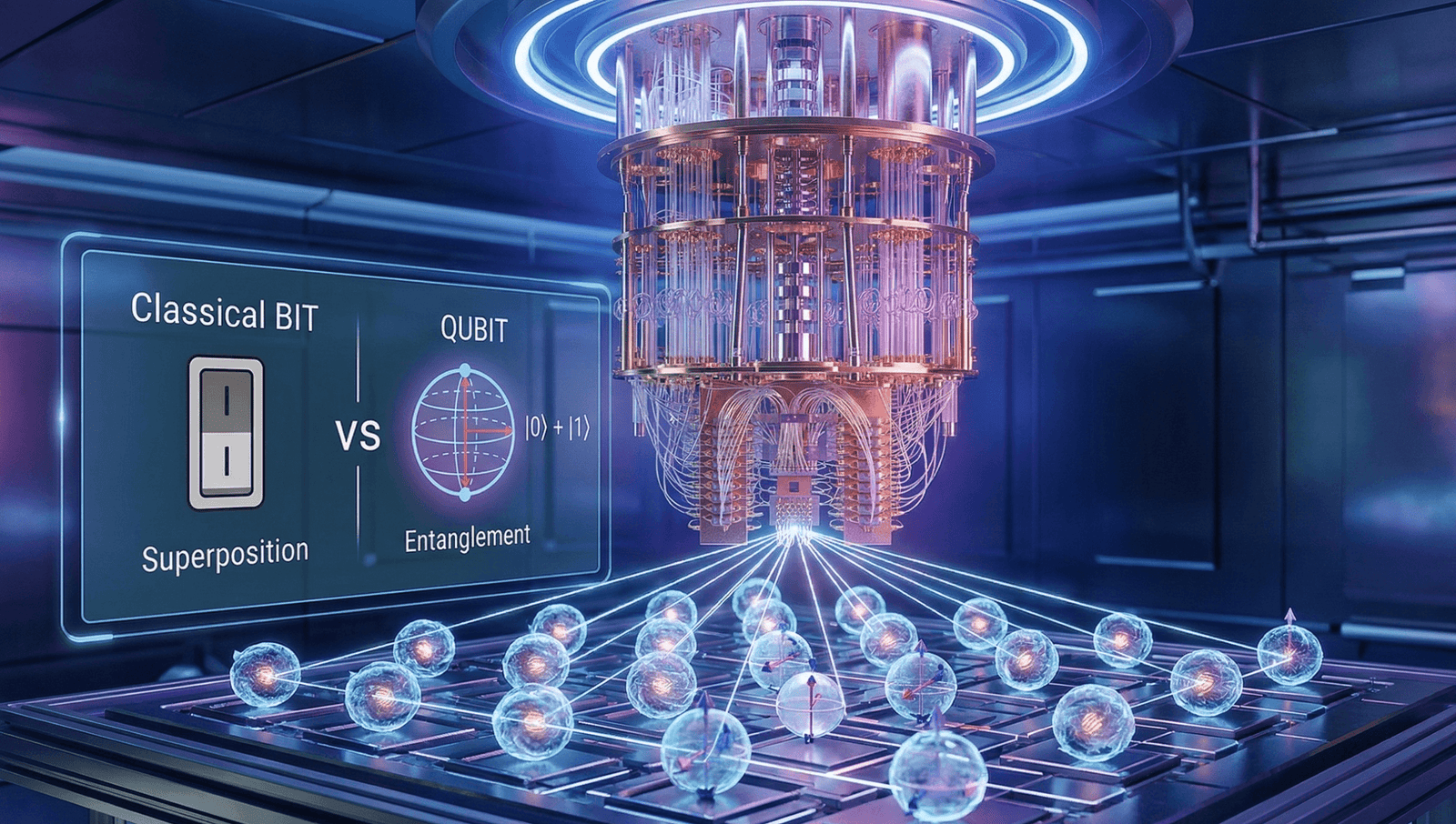
The quantum computing landscape has shifted dramatically. After years of promises and incremental progress, 2026 is proving to be the year quantum computing transitions from laboratory curiosity to real-world relevance. From Google’s record-breaking Willow chip to IBM’s aggressive roadmap for quantum advantage, the breakthroughs happening right now are setting the stage for a technological revolution that will touch every industry.
If you are a developer, tech professional, or simply someone who wants to stay ahead of the curve, understanding quantum computing in 2026 is no longer optional. In this guide, we break down every major development, explain what it means for the tech world, and show you why this year marks a genuine turning point.
Table of Contents
- What Makes 2026 a Landmark Year for Quantum Computing
- Google’s Willow Chip: The First Verifiable Quantum Advantage
- IBM’s Quantum Roadmap: Targeting Advantage by Late 2026
- Microsoft and the Rise of Neutral Atom Quantum Computing
- D-Wave’s Scalable Cryogenic Control Breakthrough
- The Fermilab-MIT Breakthrough in Ion-Trap Quantum Systems
- Triplet Superconductors: A Potential Holy Grail Discovery
- Hybrid Quantum-Classical Computing: The 2026 Standard
- Quantum Computing and Cybersecurity: The Post-Quantum Race
- Real-World Applications Taking Shape in 2026
- Challenges That Still Stand in the Way
- What Developers and Tech Professionals Should Do Now
- FAQ
What Makes 2026 a Landmark Year for Quantum Computing
For nearly a decade, the quantum computing narrative revolved around a single frustrating refrain: practical quantum computing is always five years away. That narrative is finally cracking under the weight of genuine progress.
The quantum computing industry has entered what experts are calling the “fault-tolerant foundation era.” Rather than chasing raw qubit counts, the focus has shifted to error correction, hybrid architectures, and delivering machines that customers can actually use.
Microsoft’s three-level framework for quantum progress captures this shift perfectly. Level one includes today’s noisy, intermediate-scale quantum (NISQ) computers with roughly 1,000 qubits. Level two represents small, error-corrected machines. Level three envisions large-scale systems with hundreds of thousands of qubits.
2026 is the year customers are expected to get their hands on level-two quantum computers for the first time. That alone makes quantum computing in 2026 a watershed moment for the entire technology industry.
Google’s Willow Chip: The First Verifiable Quantum Advantage
Google’s Willow processor has become the centerpiece of quantum computing progress. The 105-qubit superconducting chip achieved two landmark milestones that have reshaped the conversation.
First, Willow demonstrated exponential error reduction as it scaled up. When Google tested increasingly larger arrays of physical qubits, from 3×3 to 5×5 to 7×7 encoded grids, the error rate was cut in half each time. This accomplishment, known as “below threshold” performance, had been a central challenge in quantum error correction since Peter Shor introduced the concept in 1995.
Second, Willow ran its Random Circuit Sampling benchmark in under five minutes. A classical supercomputer attempting the same calculation would need roughly 10 septillion years, a timeframe that exceeds the entire age of the universe by an astronomical margin.
In October 2025, Google went further by demonstrating verifiable quantum advantage through its Quantum Echoes algorithm. The algorithm ran 13,000 times faster on Willow than the best classical algorithm on the Frontier supercomputer. Unlike the 2019 quantum supremacy claim, this breakthrough tackled a genuine scientific problem: analyzing molecular structures using nuclear magnetic resonance data.
Google is now opening access to the Willow chip for UK researchers through a collaboration with the UK’s National Quantum Computing Center, signaling a push toward discovering practical applications for quantum computing in 2026.
IBM’s Quantum Roadmap: Targeting Advantage by Late 2026
IBM has laid out one of the most detailed and ambitious roadmaps in the quantum space, and 2026 is a critical milestone year. The company has publicly committed to demonstrating the first example of scientific quantum advantage using a quantum computer working alongside high-performance classical computing (HPC) by the end of 2026.
At the core of IBM’s 2026 push is the Nighthawk processor. Featuring 120 qubits on a square lattice topology, Nighthawk achieved the highest coherence in IBM’s fleet. The processor can support up to 5,000 two-qubit gate operations, with future iterations expected to reach 7,500 gates by the end of 2026.
IBM also introduced the experimental Loon processor, which demonstrates the core hardware elements required for fault-tolerant quantum computing using quantum low-density parity-check (qLDPC) codes. Alongside these hardware advances, IBM shifted its quantum wafer fabrication to a 300mm facility at the Albany NanoTech Complex in New York, effectively doubling its development speed and achieving a 10x increase in chip complexity.
IBM’s ultimate target is a fully fault-tolerant quantum computer by 2029, featuring 200 logical qubits capable of 100 million error-corrected operations.
Microsoft and the Rise of Neutral Atom Quantum Computing
While Google and IBM focus on superconducting qubits, Microsoft has placed a significant bet on neutral atom quantum computing through its partnership with Atom Computing. Their joint machine, called Magne, will feature 50 logical qubits built from approximately 1,200 physical qubits and is expected to be operational by early 2027.
QuEra, another neutral atom startup, has already delivered a quantum machine ready for error correction to Japan’s National Institute of Advanced Industrial Science and Technology (AIST), with plans to make it available to global customers in 2026.
The appeal of neutral atoms lies in one word: scalability. Both QuEra and Atom Computing project that their platforms can hold upwards of 100,000 atoms in one chamber before the end of the decade. If those projections hold, neutral atoms could provide the clearest path to the third level of quantum computing in 2026 and beyond: large-scale, fault-tolerant systems.
D-Wave’s Scalable Cryogenic Control Breakthrough
D-Wave opened 2026 with a major technical milestone. The company became the first to achieve on-chip control of gate-model qubits at cryogenic temperatures in a way that scales efficiently. This matters because every qubit added to a quantum system has historically demanded more wiring, physical space, and engineering overhead.
By embedding control mechanisms directly on the chip, D-Wave has shown that growing quantum computing power does not have to mean proportionally growing complexity. The company built on strong 2025 momentum, having claimed quantum supremacy with its Advantage2 annealing system and secured a $12 million agreement to deploy its technology in Europe.
The Fermilab-MIT Breakthrough in Ion-Trap Quantum Systems
In February 2026, a partnership between Fermi National Accelerator Laboratory and MIT’s Lincoln Laboratory produced a critical advancement. The team placed ultra-low-power electronic circuits inside a cryogenic vacuum chamber alongside ion traps, then demonstrated that these circuits could reliably move and position individual ions. This approach significantly reduced unwanted thermal interference and boosted measurement precision.
The experiment tackles a fundamental scaling problem. Today’s ion-trap quantum computers depend on bulky lasers and long cables running between room-temperature control hardware and the ultra-cold trap environment. As systems grow, that wiring becomes unmanageable. By integrating miniaturized control electronics directly into the cold environment, the researchers opened a more practical path toward million-qubit ion-trap systems.
This collaboration was made possible by two U.S. Department of Energy national quantum research centers: the Quantum Science Center and the Quantum Systems Accelerator.
Triplet Superconductors: A Potential Holy Grail Discovery
In a development that could reshape the hardware foundations of quantum computing, researchers at the Norwegian University of Science and Technology reported signs of a rare triplet superconductor. The alloy NbRe appears to carry current and spin information simultaneously without any energy loss, a behavior not seen in conventional superconducting materials.
If confirmed through further experiments, this type of material could make quantum processors far more stable while drastically cutting the power they consume. The potential to move charge and spin data at the same time, with zero dissipation, would represent a foundational hardware improvement for next-generation quantum systems. This remains early-stage research, but the implications for quantum computing in 2026 and beyond are significant.
Hybrid Quantum-Classical Computing: The 2026 Standard
One of the defining trends of quantum computing in 2026 is the rise of hybrid quantum-classical architectures. Rather than expecting quantum systems to replace classical ones entirely, the industry has embraced a model where quantum processors work alongside traditional computing resources to tackle specific problems more efficiently.
NVIDIA’s launch of NVQLink, enabling direct communication between quantum processing units (QPUs) and GPUs, underscores this direction. Seventeen quantum computing companies and eight U.S. Department of Energy national laboratories have already joined the NVIDIA quantum ecosystem.
Hybrid architectures are proving particularly valuable for accelerating AI model training, reducing energy consumption, and enabling work with smaller datasets. Cloud providers like IBM, AWS, and Microsoft are expected to further integrate quantum-classical hybrid resources into their platforms throughout 2026.
Quantum Computing and Cybersecurity: The Post-Quantum Race
The cybersecurity implications of quantum computing have moved from theoretical concern to urgent priority in 2026. Breakthroughs in quantum processor power, combined with multi-billion-dollar infrastructure buildouts, suggest that a cryptography-breaking machine may arrive sooner than previously expected.
Organizations are scrambling to adopt post-quantum cryptography (PQC). The 2024 standardization of FIPS 203 cleared the path for deployment, and U.S. federal agencies now face mandates to inventory and replace vulnerable encryption within the decade. “Harvest-now, decrypt-later” espionage campaigns, where adversaries collect encrypted data today to decrypt it once quantum computers are powerful enough, have intensified awareness across governments and enterprises.
Quantum key distribution (QKD) is also gaining traction as a method for creating secure communication channels that can detect interception attempts and ensure data confidentiality. The race to secure critical infrastructure before “Q-Day” arrives is now one of the most urgent priorities in cybersecurity.
If you are interested in how AI is already transforming cybersecurity strategies, check out our article on how AI agents are changing the way we work in 2026.
Real-World Applications Taking Shape in 2026
The progress of quantum computing in 2026 is no longer confined to abstract benchmarks and academic exercises. The first industrial pilots are emerging across several key sectors.
Drug Discovery and Healthcare: Quantum computers are being used to simulate complex molecular interactions with unprecedented precision. Google’s collaboration with pharmaceutical companies to simulate key human enzymes involved in drug metabolism represents a significant step toward accelerating drug development timelines.
Finance: JPMorgan Chase’s partnership with IBM to explore quantum algorithms for option pricing and risk analysis has shown that quantum models could outperform classical Monte Carlo simulations. Portfolio optimization, derivatives pricing, and risk assessment are all areas where quantum computing is expected to deliver early value.
Logistics and Supply Chain: IBM’s partnership with a commercial vehicle manufacturer used a combination of classical and quantum computing to optimize deliveries across 1,200 New York City locations. Quantum algorithms are proving effective at processing large datasets to identify the most efficient routes, reducing both travel time and fuel consumption.
Materials Science and Energy: Quantum simulations are enabling researchers to explore new materials for batteries, semiconductors, and renewable energy systems that would be impossible to model on classical computers.
Challenges That Still Stand in the Way
Despite the remarkable progress, quantum computing in 2026 still faces significant hurdles. Current logical error rates, around 0.14% per cycle, remain far above the 10⁻⁶ levels believed necessary for running meaningful large-scale quantum algorithms.
Scaling from hundreds to millions of qubits requires not just better hardware, but revolutionary advances in manufacturing, wiring, signal delivery, power management, temperature control, and automated calibration. A University of Chicago-led paper published in Science compared this moment to the early era of classical computing before the transistor reshaped modern technology, noting that many breakthrough innovations took years or even decades to move from labs into industrial production.
On the software side, quantum algorithms and programming frameworks remain underdeveloped compared to the robust ecosystems available for classical computing. The workforce gap is another critical concern: organizations need experts in quantum algorithms, AI research, and hybrid quantum-classical systems, and demand currently far outstrips supply.
What Developers and Tech Professionals Should Do Now
The quantum computing wave is building, and tech professionals who prepare now will have a significant advantage. Here are practical steps you can take today.
Start by building foundational knowledge. Understanding concepts like qubits, superposition, entanglement, and error correction will be essential as quantum technologies become integrated into mainstream development workflows. IBM’s Qiskit and Google’s Cirq are both open-source frameworks that let you experiment with quantum circuits on simulators and real hardware.
Explore hybrid quantum-classical computing. As NVIDIA’s CUDA-Q platform and cloud-based quantum services expand, familiarity with hybrid architectures will become a valuable differentiator for developers working in AI, optimization, and scientific computing.
Stay informed about post-quantum cryptography. If you work in cybersecurity or build applications that handle sensitive data, understanding PQC standards and migration strategies is already a professional requirement. Mastering these emerging skills is part of the broader shift in AI-era tech skills every developer needs in 2026.
FAQ
What is the biggest quantum computing breakthrough in 2026?
Google’s demonstration of verifiable quantum advantage using the Quantum Echoes algorithm on its Willow chip is widely considered the most significant breakthrough. The algorithm ran 13,000 times faster than the best classical approach on the Frontier supercomputer.
Is quantum computing commercially available in 2026?
Quantum computing is transitioning to early commercial availability in 2026. IBM, Google, Microsoft, and startups like QuEra are delivering error-corrected machines and cloud-based quantum access to select customers and research partners.
How does quantum computing affect cybersecurity?
Quantum computers threaten current encryption methods like RSA and ECC. Organizations are adopting post-quantum cryptography (PQC) and quantum key distribution (QKD) to protect data before quantum machines become powerful enough to break existing encryption.
What programming languages are used for quantum computing?
Python is the dominant language for quantum development, with frameworks like IBM’s Qiskit and Google’s Cirq providing tools for building and testing quantum circuits on simulators and real hardware.
When will quantum computers replace classical computers?
Quantum computers are not expected to replace classical computers. Instead, hybrid quantum-classical architectures are emerging as the standard model, where quantum processors handle specific tasks that are computationally intractable for classical systems.
What industries will benefit most from quantum computing?
Pharmaceuticals, finance, logistics, materials science, and cybersecurity are leading the adoption of quantum computing in 2026, with pilot programs and early use cases already underway.