

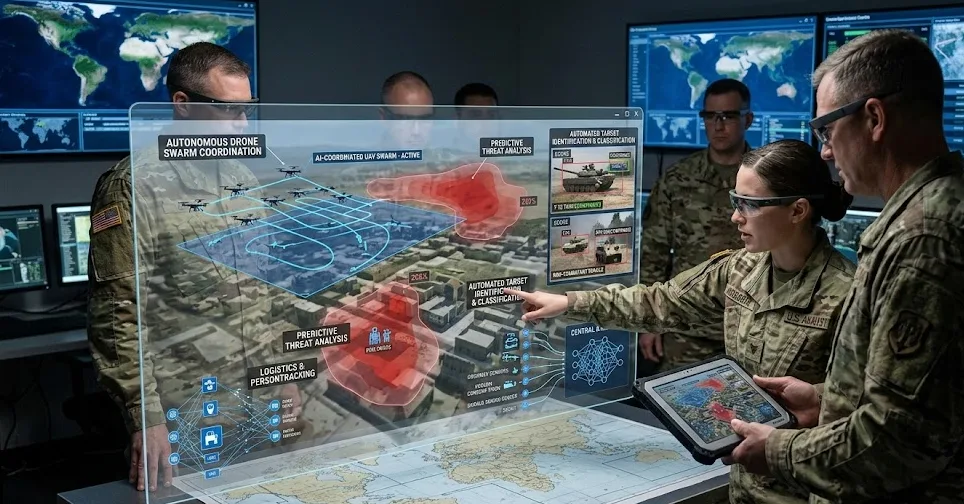
The Iran-Israel-US conflict has crossed a threshold that military analysts have long anticipated, and AI warfare is at its center. This is no longer a conventional geopolitical confrontation — it is the first full-scale, high-intensity war in which artificial intelligence, autonomous drones, and coordinated cyberattacks are operating simultaneously as primary instruments of combat. The battlefield is no longer purely physical. It is digital, algorithmic, and increasingly autonomous.
In this post, we break down exactly how AI warfare is being deployed by all sides — and what this conflict is revealing about the future of modern combat.
Table of Contents
- AI-Guided Targeting: Strikes at Machine Speed
- Drone Swarms: The $35,000 Weapon That Changed Everything
- Cyberwarfare: The Invisible Front
- Iran’s AI Arsenal: Asymmetric and Adaptive
- AI in Defense: Missile Shields and Predictive Interception
- The Ethical Questions AI Warfare Is Forcing Us to Ask
- The Bottom Line
- Frequently Asked Questions
AI-Guided Targeting: Strikes at Machine Speed
Perhaps the most significant development in this conflict is the speed at which AI-assisted targeting has operated. In the first 12 hours of joint US-Israeli offensive operations, US-Israeli forces executed nearly 900 strikes on Iranian targets — an operational tempo that traditional planning methods would have required days or weeks to achieve.
According to reports from multiple intelligence sources, Israel’s Mossad and military intelligence used AI systems to process vast streams of data — including drone feeds, satellite imagery, and intercepted communications — generating targeting recommendations at speeds no human team could match. These systems compressed historically week-long planning cycles down to hours, or in some cases, minutes.
This is not an entirely new capability. Israel previously deployed AI tools like The Gospel and Lavender during the Gaza conflict and operations against Hezbollah in Lebanon to automatically sift through surveillance data and generate strike target lists. The Iran operation, however, represents a significantly more sophisticated deployment — refined over years of operational use and now functioning at a national-level scale.
The US side brought formidable capabilities of its own. The Pentagon’s Project Maven, a machine learning initiative launched in 2017, analyzes imagery and supports targeting decisions across multiple conflict zones. For the Iran operation, US cyber and space assets moved first — degrading Iranian surveillance, communications, and command-and-control infrastructure before a single kinetic strike began. AI-assisted battlefield intelligence from companies like Palantir Technologies, whose platforms build virtual digital twins of physical locations, also played a role in real-time targeting decisions. According to US Department of Defense reporting, the integration of AI into targeting workflows marks one of the most significant operational shifts in modern military history.
Drone Swarms: The $35,000 Weapon That Changed Everything
One of the most consequential moments in this conflict came with a single official confirmation: US Central Command announced it deployed LUCAS drones in combat for the first time. Built by Phoenix-based Spektreworks Inc., these one-way attack drones cost just $35,000 each — and engineers modeled them directly on Iran’s own Shahed-136 design.
The strategic irony is striking. Iran pioneered cheap, expendable suicide drones to overwhelm more expensive air defense systems. The US studied that playbook, adapted it, and deployed its own version. Specifically, LUCAS drones targeted Iranian anti-aircraft radar systems — complementing conventional fighter jets and cruise missiles in a combined high-low approach that military analysts describe as a fundamental shift in offensive cost-effectiveness.
Iran, meanwhile, deployed its Shahed-series drones in enormous numbers throughout the conflict. During the early days of fighting, Iran launched over 1,000 Shahed drones alongside hundreds of ballistic missiles targeting Israeli and US military assets across the wider region. Each drone, priced between $20,000 and $50,000, serves a deliberate purpose: not necessarily to penetrate defenses, but to exhaust and overwhelm layered air defense systems — forcing expensive interceptors to engage cheap targets until stockpiles critically deplete.
This attritional math has become one of the defining strategic problems of the conflict. Technological superiority does not neutralize financial asymmetry when a $35,000 drone forces the launch of a $1 million interceptor. Consequently, the side that sustains drone production longest holds a structural advantage that precision firepower alone cannot overcome.
Cyberwarfare: The Invisible Front
Alongside the kinetic strikes, a coordinated cyber campaign ran in parallel. Attackers compromised Iranian news websites, hackers infiltrated a widely-used religious calendar app to display political messaging urging soldiers to lay down arms, and a near-total internet blackout blanketed Iran during peak operations.
This cyber dimension has deep historical roots. The Stuxnet worm, widely attributed to a joint US-Israeli operation, demonstrated over a decade ago that software could physically destroy industrial infrastructure — in that case, centrifuges at Iran’s Natanz nuclear facility. Moreover, the doctrine Stuxnet established has evolved into something far more comprehensive: cyber operations now function as a synchronized component of combined-arms campaigns rather than standalone covert actions.
Iran responded with significant offensive cyber capabilities of its own. Iranian-linked groups including APT33 and MuddyWater have historically conducted espionage and infrastructure sabotage against regional adversaries. Following the initial strikes, pro-Iranian hacktivists escalated attacks by an estimated 700 percent, targeting Israeli energy grids and medical facilities. Furthermore, these groups increasingly leverage AI to lower the barrier to entry for sophisticated attacks — enabling less technically skilled proxies to execute operations that previously required specialist expertise.
Iran’s AI Arsenal: Asymmetric and Adaptive
Iran is not merely a passive target in this technological confrontation. Tehran has made deliberate investments in AI-enabled asymmetric capabilities designed to offset the conventional military advantages of its adversaries.
On the hardware side, Iran developed AI-augmented unmanned ground vehicles — including a system called the Aria robot — for surveillance and potential combat roles. On the information warfare front, Iranian entities deployed generative AI to produce deepfakes and propaganda content at scale. During the conflict, AI-generated videos depicting fabricated destruction in Israeli cities spread widely across social media, specifically designed to manipulate international perception and boost domestic morale.
This is disinformation as a strategic weapon — a domain where AI has fundamentally lowered production costs while simultaneously raising the difficulty of rapid attribution. For the broader technology community, this represents one of the most sobering real-world demonstrations of how generative AI can influence military and geopolitical outcomes far beyond the digital sphere.
AI in Defense: Missile Shields and Predictive Interception
Defensive AI proved equally central to the operational picture. Israel’s layered air defense architecture — comprising Arrow 3 (exo-atmospheric), David’s Sling (medium-range), and Iron Dome (short-range) — incorporates AI-enhanced predictive analytics for rapid threat response. During the June 2025 exchanges, Israel claimed an 86 percent interception rate against incoming Iranian missiles — a figure that would be operationally impossible without AI-assisted coordination given the simultaneous volume and velocity of incoming threats.
However, even at these interception rates, the sheer volume of Iranian launches placed severe strain on interceptor stockpiles. This is Iran’s deliberate attritional strategy: exhaust the shield rather than defeat it outright. Every interceptor fired leaves one fewer available for the next wave, and even the most advanced system has physical and financial limits that a sustained campaign can exploit.
Counter-drone AI platforms like Dedrone and EnforceAir use AI-driven detection and radio-frequency analysis to identify and neutralize incoming drone swarms non-kinetically — an increasingly critical capability as attack drone costs continue to fall and availability rises across all parties to the conflict. Understanding how AI makes these real-time decisions is explored further in our guide to how AI agents are changing the way we work in 2026.
The Ethical Questions AI Warfare Is Forcing Us to Ask
The scale and speed of AI warfare in this conflict has reignited urgent debates about autonomous weapons and the meaning of human oversight. When AI systems generate targeting recommendations and compress planning cycles from days to minutes, what does meaningful human control actually look like in practice? At what point does operational speed conflict with international legal principles of distinction, proportionality, and precaution in targeting?
Research placing AI models inside simulated nuclear-crisis wargames found these systems consistently defaulted toward escalation — selecting nuclear options in the vast majority of test scenarios rather than choosing de-escalation pathways. These simulations do not directly predict real-world AI battlefield behavior. Nevertheless, they highlight a systemic risk in deploying strategic AI systems into high-stakes environments without robust, genuinely enforceable human override mechanisms.
Dozens of countries have signed a US-led Political Declaration on Responsible Military Use of Artificial Intelligence and Autonomy, endorsing principles of human oversight for lethal AI systems. However, declarations and operational reality are diverging rapidly in active conflict zones. This war may ultimately force the international community to move from voluntary commitments toward binding frameworks — or it may demonstrate that such frameworks are simply unenforceable when strategic interests are directly at stake. For a deeper look at the AI ethics debate shaping this technology, read our analysis on why responsible AI development matters now more than ever.
The Bottom Line
The Iran-Israel-US conflict is a defining moment for AI warfare — not because AI has replaced human decision-making, but because it has fundamentally changed the speed, scale, and nature of how military force is planned, executed, and contested. AI-assisted targeting compresses planning cycles from days to minutes. Cheap autonomous drones have democratized lethal capability on all sides. Coordinated cyberattacks and AI-generated disinformation now run in parallel to kinetic operations. And layered AI-enhanced missile defense is the only thing making it operationally viable to intercept hundreds of simultaneous incoming threats.
What this conflict makes undeniable is that AI warfare is no longer a future consideration for military planners — it is a present-tense operational reality. How the international community chooses to govern that reality will be one of the most consequential technology policy decisions of this decade.
Frequently Asked Questions
How is AI warfare being used in the Iran-Israel-US conflict?
AI warfare in this conflict spans targeting, defense, and information operations. Israel’s Mossad used AI to process massive datasets and select strike targets, compressing planning cycles from days to hours. The US deployed AI-enhanced missile defense and battlefield intelligence systems. Iran, in turn, uses AI for drone coordination, deepfake propaganda, and amplified cyber operations.
What are LUCAS drones and why do they matter?
LUCAS are low-cost, one-way attack drones built by Spektreworks Inc. and used by the US military in combat for the first time during this conflict. At $35,000 each and modeled on Iran’s Shahed-136 design, they signal a major strategic shift: cheap autonomous weapons now belong in the US military’s standard offensive toolkit alongside expensive conventional platforms.
What is Iran’s cyber warfare capability?
Iran operates significant offensive cyber capabilities through groups like APT33 and MuddyWater. During this conflict, pro-Iranian hacktivists escalated attacks by an estimated 700 percent, targeting Israeli energy and medical infrastructure. Iran also uses generative AI to produce propaganda and deepfake content as part of its broader information warfare strategy.
Are AI-powered autonomous weapons legal under international law?
This remains a contested and rapidly evolving area of international law. International humanitarian law requires weapons to comply with principles of distinction, proportionality, and military necessity. While a US-led political declaration on responsible military AI has attracted dozens of signatories, binding treaty-level frameworks specifically governing lethal autonomous weapon systems do not yet exist at the international level.