

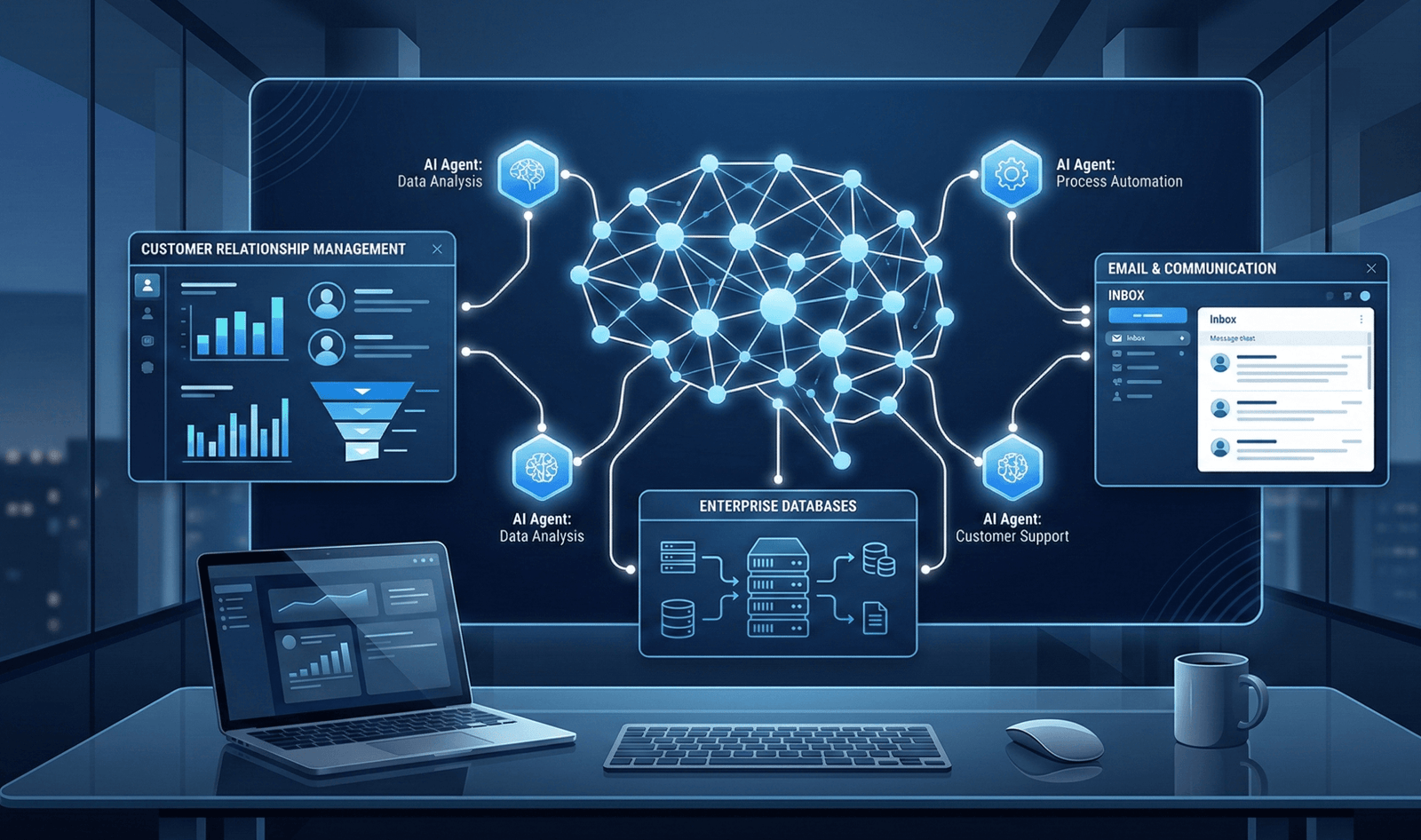
If you’ve been hearing the term AI agents everywhere lately and wondering what it actually means – you’re not alone. It’s one of the most talked-about concepts in enterprise technology right now, and for good reason. AI agents aren’t just the next shiny buzzword. They represent a genuine shift in how software works, how businesses operate, and how humans interact with technology.
This guide breaks it all down in plain English – what AI agents are, why they matter in 2026, how they’re being used right now, and what your business should know before getting started with AI agents explained 2026.
The AI Agent Opportunity in 2026: By the Numbers
Less than 5% to 40%
Enterprise apps integrating AI agents by end of 2026, up from less than 5% in 2025 (Gartner)
72%
Medium and large enterprises already using agentic AI in some form (Gravitee Survey, 2025)
1. So… What Exactly Is an AI Agent?
Let’s start with the basics. Most of us are familiar with AI as something that responds to a question or generates content when you ask it to. Think of a chatbot answering your customer service query, or a tool suggesting the next word in a sentence. That’s reactive AI – it waits for you, does one thing, and stops.
An AI agent is fundamentally different. It’s a system that can:
- Set its own sub-goals to achieve a larger objective
- Plan a sequence of steps and actually execute them
- Use tools, APIs, databases, and other software autonomously
- Learn from outcomes and adapt in real time
- Work across multiple systems without a human guiding each move
If traditional AI is a very smart calculator that answers questions, an AI agent is more like a capable employee who receives a brief, figures out the steps, uses the right tools, and comes back with a finished result.
The technical definition: AI agents are semi-autonomous, self-learning systems capable of handling complex tasks. They learn from past interactions, make real-time decisions, plan execution, adjust behavior based on live data, and coordinate with tools and APIs to accomplish goals.
2. AI Agents vs. Traditional AI: What’s the Real Difference?
| Feature | Traditional AI | AI Agents |
|---|---|---|
| Decision-making | Requires human input at every step | Autonomous multi-step decisions |
| Memory | Single interaction only | Persistent context and learning |
| Task scope | One task at a time | Complex, multi-system workflows |
| Tools used | Limited to one model | Connects APIs, apps and databases |
| Human role | Operator for every step | Supervisor / Agent Boss |
| Best suited for | Answering questions, generating content | Running entire business processes |
The key shift is autonomy and scope. Traditional AI answers a question. An AI agent completes a mission. That’s the difference between asking someone “What’s the weather?” versus “Plan my travel for next week, book the best option, and add it to my calendar.”
3. How Do AI Agents Actually Work?
A Large Language Model (LLM) as the Brain

The LLM is what makes the agent intelligent – it understands language, reasons about problems, and decides what steps to take next. GPT-4, Claude, and Gemini are common examples powering today’s enterprise agents.
Tool Access
Unlike a chatbot that only talks, an AI agent can actually do things – browse the web, run a search, read a file, send an email, query a database, or call an API. Tools are the agent’s hands, enabling real-world action.
Memory
AI agents maintain context across a conversation or workflow. They remember what happened earlier in the task and use that to make better decisions – unlike traditional AI, which forgets between interactions.
Goal-Oriented Planning
Given a high-level goal (e.g., “onboard this new customer”), the agent breaks it into steps, executes each one, checks the result, and adjusts. No hand-holding required at each stage.
Multi-Agent Collaboration
In advanced deployments, multiple AI agents work as a team – each specializing in part of the process. One analyzes data, another executes actions, and a third monitors quality and escalates issues. This mirrors how high-performing human teams operate on complex projects.
4. Real-World Use Cases: Where AI Agents Are Delivering Results in 2026
| Industry | What AI Agents Do | Measured Impact |
|---|---|---|
| Customer Support | Triage tickets, auto-reply, escalate complex issues | 70% routine query deflection |
| Finance and Banking | KYC checks, fraud detection, invoice reconciliation | 70-90% reduction in processing time |
| Healthcare | Update EHRs, schedule patients, flag health anomalies | Faster, more accurate diagnosis support |
| HR and Recruiting | Screen resumes, schedule interviews, and manage onboarding | Hours saved per hire cycle |
| IT Operations | Monitor infrastructure, resolve tickets, prevent outages | 44% ROI on deployments |
| Sales and Marketing | Prospect research, outreach sequences, CRM updates | Scale outbound at human quality |
| Supply Chain | Demand forecasting, route optimization, disruption response | 22% cost savings |
Customer Support: The Most Mature Agentic Application
Autonomous customer support is the most mature agentic AI application in 2026. Agents triage tickets, pull context from multiple systems, and escalate only complex issues to human agents – complete with full conversation history. Teams report deflecting up to 70% of routine requests without human involvement.
IT Operations: From Firefighting to Proactive Management
AI agents in IT continuously monitor infrastructure, detect anomalies, investigate root causes, and resolve known issues autonomously. Enterprise IT teams report 44% ROI from agentic IT operations – transforming reactive teams into proactive ones.
Finance: Speed, Accuracy, and Compliance at Scale
Agents handle KYC checks, monitor transactions for fraud in real time, and reconcile invoices against purchase orders. Tasks that previously took analysts days now complete in minutes – with higher accuracy and built-in audit trails.
5. The “Agent Boss”: What This Means for Workers
The narrative is not “AI agents replace humans.” The more accurate picture is a shift in roles. Microsoft has coined a new title for this emerging role: the Agent Boss – the person who:
- Defines the goal and guardrails for the AI agent
- Reviews and approves outputs at key decision points
- Manages a portfolio of agents across business functions
- Focuses on strategy, exceptions, and high-value judgment calls
We’re moving from human-in-the-loop – where humans are a bottleneck at every step – to human-on-the-loop – where humans supervise and steer while agents handle execution. This is arguably the biggest workplace shift since the personal computer.
McKinsey research highlights that AI agents could improve enterprise productivity by up to 40% when embedded across departments.
6. Why 2026 Is the Inflection Point for AI Agents
- Models got dramatically smarter. LLMs powering agents are far more capable at reasoning and planning than 18 months ago.
- Tool ecosystems matured. Standards like MCP (Model Context Protocol), launched in late 2024, allow agents to connect to enterprise systems in a standardized, secure way.
- Governance caught up. Organizations now build agents with proper security, audit trails, and human-in-the-loop controls from day one.
- Business pressure intensified. With talent shortages and pressure to do more with less, AI in experimentation mode is no longer acceptable.
7. Common Misconceptions About AI Agents
- Myth: AI agents are fully autonomous. Reality: Most production agents operate within defined guardrails with human oversight for high-risk decisions.
- Myth: AI agents will replace your entire team. Reality: They automate repetitive tasks – freeing your team for creative and judgment-intensive work.
- Myth: Building an AI agent is easy. Reality: Gartner predicts over 40% of agentic AI projects will be scrapped by 2027 due to governance and integration challenges.
- Myth: You need to start big. Reality: The most successful deployments start with two or three focused use cases with clear KPIs.
8. How to Get Started: A Practical 6-Step Roadmap
- Identify your highest-friction workflows – where do teams spend the most time on repetitive, rule-based tasks?
- Pick one or two focused use cases with clear success criteria measurable within 90 days.
- Map your data and system landscape – agents need access to your tools, databases, and APIs.
- Define governance upfront – who approves agent actions? What decisions require human sign-off?
- Choose an orchestration platform – options include Microsoft Copilot Studio, Salesforce Agentforce, ServiceNow, or Kore.ai.
- Measure and iterate – track time saved, error rates, cost per task, and satisfaction scores. Then expand.
Frequently Asked Questions About AI Agents
What is the difference between an AI agent and a chatbot?
A chatbot responds to one question at a time and cannot take action in the real world. An AI agent can plan multi-step workflows, use external tools, maintain memory across tasks, and execute actions autonomously to achieve a goal.
Are AI agents safe to use in enterprise environments?
Yes, when properly governed. The key is designing agents with defined permissions, audit logs, human-in-the-loop controls for high-risk decisions, and integration into existing security frameworks. Most enterprise platforms provide these guardrails out of the box.
How much do AI agents cost?
Consumer-grade AI agents start at $20-$50 per month. Enterprise platforms are usage-based. High-performing enterprises report an average 4.5x return on investment (KPMG/McKinsey, 2025).
What industries benefit most from AI agents?
Financial services, healthcare, manufacturing, retail, and IT operations are seeing the fastest adoption and highest ROI. Any industry with high-volume, repetitive knowledge work is a strong candidate.
The Bottom Line
AI agents represent the most significant shift in enterprise technology since the cloud. They’re moving AI from a productivity accessory to a core business system – one that can plan, act, learn, and deliver results across entire workflows without constant human supervision.
2026 is the year this stops being a future promise and becomes a present reality. Organizations moving now – carefully, with proper governance and a focus on measurable outcomes – are building the competitive foundations that will define the next decade.
The question is no longer “should we explore AI agents?” It’s “which process do we transform first?”