

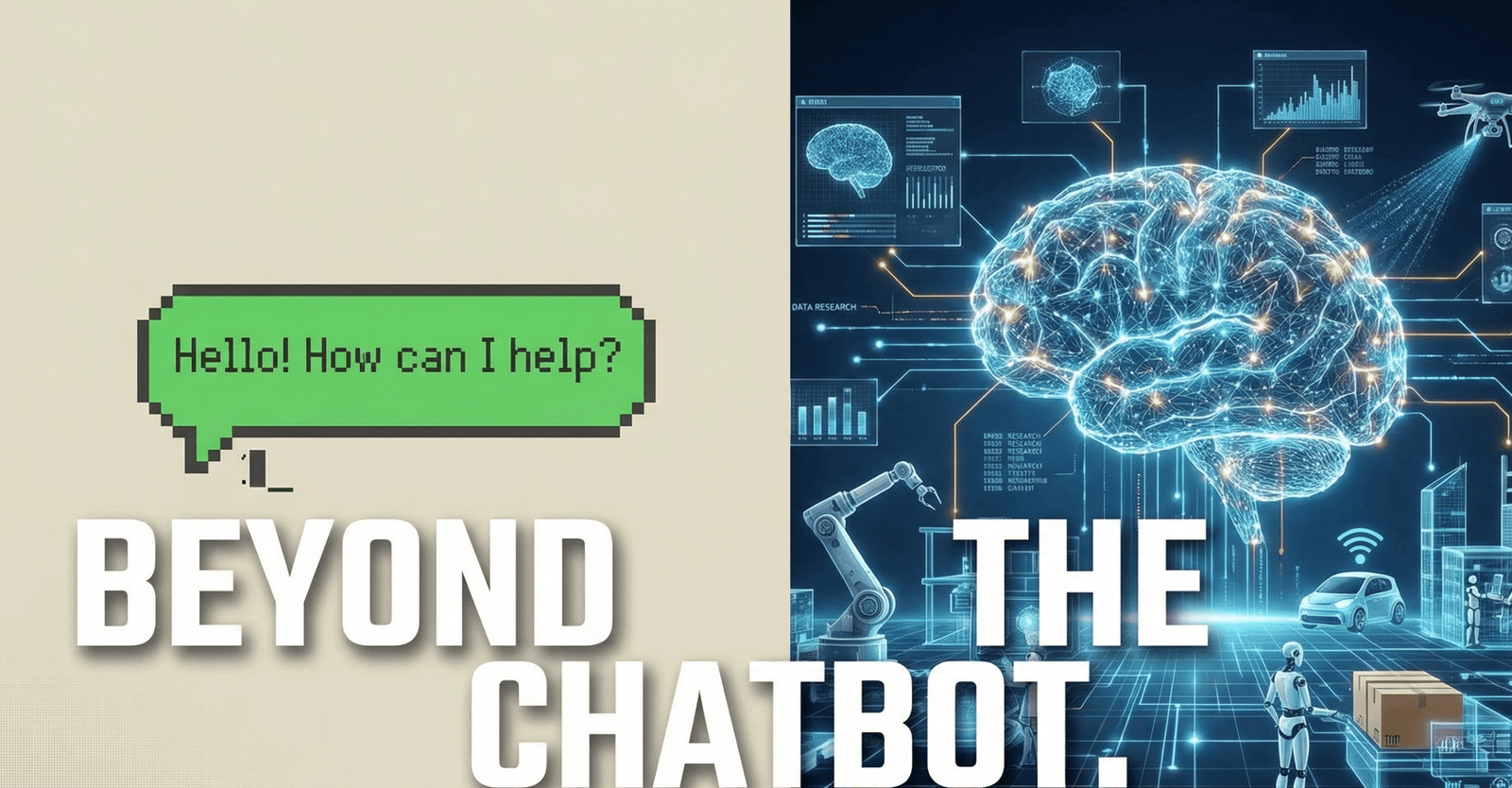
The biggest tech trend of 2026 is not another chatbot upgrade. It is agentic AI 2026 — a fundamental shift from AI systems that respond to queries to autonomous agents that independently plan, reason, and execute complex, multi-step tasks on your behalf. If you work in software development, enterprise tech, or any field touched by automation, this shift will reshape how you work.
In this guide, we break down exactly what agentic AI is, how it differs from the chatbots you know, and what the most important trends look like in practice. We also cover the risks, the developer opportunities, and what you need to do right now to stay ahead.
Table of Contents
- What Is Agentic AI?
- Chatbots vs. Autonomous Agents: What Changed
- Market Growth and Enterprise Adoption in 2026
- 7 Key Agentic AI Trends Reshaping 2026
- Real-World Use Cases for Developers and Engineers
- Risks, Security Threats, and Governance
- Developer Opportunities: What You Should Learn Now
- Frequently Asked Questions
1. What Is Agentic AI?
Agentic AI refers to AI systems that are semi- or fully autonomous — capable of perceiving their environment, reasoning about a goal, and taking actions to achieve it without continuous human instruction. Unlike a standard large language model (LLM) that responds to a single prompt, an agent assembles resources, creates plans, and executes multi-step workflows across tools and applications.
MIT Sloan professor Sinan Aral put it plainly: the agentic AI age is already here, with agents deployed at scale across industries to perform all kinds of tasks. These systems integrate directly with software platforms — databases, APIs, browsers, and code editors — giving them the ability to operate in the real world rather than just generate text.
The core components of any AI agent are perception (understanding input from tools or users), reasoning (planning the steps to achieve a goal), and action (executing those steps via tool calls, API requests, or code). This makes them structurally different from even the most advanced chatbots, which are primarily reactive rather than proactive.
2. Chatbots vs. Autonomous Agents: What Changed
Traditional chatbots operate on a simple loop: receive input, generate output, wait for the next prompt. They are excellent at answering questions, summarizing text, and handling structured conversations. However, they cannot take initiative, maintain long-running goals, or execute tasks independently across multiple systems.
Autonomous agents break this loop entirely. We are moving from instruction-based computing — where you tell a system exactly how to do something — to intent-based computing, where you state a goal and the agent determines how to get there. A chatbot might help you draft an email; an agent can research your prospect, draft the email, pull their LinkedIn data, schedule the meeting, and update your CRM — all autonomously.
This is why understanding prompt engineering in 2026 is evolving fast. The skill is no longer just about crafting the perfect single prompt — it is about designing the orchestration layer between multiple specialized agents. How one agent hands off context to another is fast becoming the most critical engineering challenge of the year.
3. Market Growth and Enterprise Adoption in 2026
The numbers behind agentic AI are staggering. Industry analysts project the global agentic AI market will surge from approximately $7.8 billion today to over $52 billion by 2030. Gartner predicts that 40% of enterprise applications will embed AI agents by the end of 2026, up from less than 5% in 2025. IDC expects AI copilots to be embedded in nearly 80% of enterprise workplace applications in the same period.
Despite the explosive momentum, adoption remains uneven. Deloitte’s research shows that while 30% of organizations are exploring agentic options and 38% are piloting solutions, only 14% have production-ready deployments. The gap between experimentation and scale is 2026’s defining challenge for enterprise tech leaders.
McKinsey estimates that agentic AI-driven productivity gains could unlock up to $2.9 trillion in economic value by 2030. Organizations already using AI-centric architectures are reportedly achieving 20–40% reductions in operating costs and 12–14 point increases in EBITDA margins. These are not projections for the distant future — they are happening right now.
4. Seven Key Agentic AI Trends Reshaping 2026
Trend 1: Multi-Agent Collaboration via Model Context Protocol (MCP)
Single-agent systems are giving way to multi-agent ecosystems. The Model Context Protocol (MCP) is emerging as the standard that allows agents to connect seamlessly with diverse data sources and tools — from BigQuery to cloud storage to enterprise APIs — and hand off tasks between each other in coordinated workflows. Think of it as the HTTP of the agentic web.
In practice, this looks like digital assembly lines: a data agent monitors market trends overnight, a content agent drafts a campaign brief, a creative agent generates visuals, and a reporting agent analyzes the results — all in a seamless, human-supervised pipeline. Developers who master orchestration design will be the most valuable engineers of 2026.
Trend 2: Long-Running Agents That Work for Days
Early AI agents handled tasks that completed in minutes. By late 2025, agents could produce full feature sets over several hours. In 2026, agents are capable of working autonomously for days at a time — building entire applications, running test suites, refining outputs, and reporting back to humans only at key decision points. This is a fundamental change in the software development lifecycle.
Consequently, the engineering focus is shifting from writing code to reviewing agent-generated code. Humans are becoming strategic overseers rather than line-by-line implementers. Organizations that build this human-AI collaboration model correctly will compress weeks of development work into focused working sessions.
Trend 3: Agent Cost Optimization as a Core Architecture Concern
Running multi-agent systems at scale is expensive. In 2026, forward-thinking organizations are building economic models into their agent design from day one — not retrofitting cost controls after deployment. This mirrors the cloud cost optimization movement of the microservices era: the teams that build cost awareness into their architecture win.
Trend 4: The Rise of Agent-Native Startups
A three-tier ecosystem is forming around agentic AI. Tier 1 is dominated by hyperscalers providing foundational compute and base models. Tier 2 consists of established enterprise vendors embedding agents into existing platforms. Tier 3 — the most disruptive — is an emerging class of agent-native startups building products where autonomous agents are the primary interface, not supplementary features.
Trend 5: Deep Research Agents in Enterprise Intelligence
One of the most impactful agentic AI use cases is Deep Research Agents. Without human intervention, these agents collect data autonomously, evaluate sources, cross-verify facts, and deliver high-quality insights faster than any human analyst. In finance, healthcare, and defense, this capability is transforming competitive intelligence operations entirely.
Trend 6: Agentic Security Operations Centers (SOCs)
Cybersecurity is being transformed by agentic AI on both sides of the battlefield. Defensive Agentic SOCs use task-based agents to move from flagging alerts to actively investigating, analyzing malware, and recommending responses in real time. This elevates human analysts from tactical responders to strategic defenders. On the offensive side, threat actors are deploying agentic tools that can plan, adapt, and persist autonomously across multi-stage attacks.
Trend 7: Governance Frameworks and Bounded Autonomy
As agent autonomy increases, governance frameworks are becoming non-negotiable. Leading organizations are implementing bounded autonomy architectures with clear operational limits, defined escalation paths to humans for high-stakes decisions, and comprehensive audit trails of every agent action. Gartner predicts that over 40% of agentic AI projects will fail by 2027 because organizations failed to build governance infrastructure early enough.
5. Real-World Use Cases for Developers and Engineers
Agentic AI is already being deployed in production across a range of domains that directly affect developers and engineers. In software development, agents now act as autonomous first-pass executors across the SDLC: they analyze feasibility during planning, implement features during build, expand test coverage during validation, and surface risks during review — all without constant human prompting.
In telecommunications, agents can autonomously detect network anomalies, open a field service ticket, and alert the customer in one integrated sequence. In sales, AI agents can identify leads, schedule meetings, and adjust their approach based on client behavior data. In legal tech platforms, agentic workflows are integrated throughout entire document review pipelines. The breadth of deployment is already significant.
For developers specifically, this means your role is shifting. As we explored in our post on how AI agents are changing the way we work in 2026, the highest-value skill is no longer implementation — it is orchestration design, architectural trade-off analysis, and maintaining accountability over agent-generated outputs. You become the conductor, not the musician.
6. Risks, Security Threats, and Governance
Agentic AI introduces risks that traditional software simply does not. Unlike conventional systems that execute predefined logic, agents make runtime decisions, access sensitive data, and take actions with real business consequences — often faster than a human can review them. A single misconfigured agent can create a cascading failure across an interconnected system of tools.
On the security side, agentic AI is already a confirmed threat multiplier. Ransomware groups and sophisticated threat actors are deploying agentic systems that can plan, adapt, and retry attacks autonomously. Tasks that previously required an experienced attacker to coordinate over days can now be delegated to an agent running continuously until it achieves its goal or is shut down. Strong identity controls, network segmentation, and behavior-based detection remain the most effective defenses.
Organizationally, the biggest risk is the governance gap: most enterprises are deploying agents faster than they can secure or govern them. Organizations that solve this first — by building accountability structures, audit trails, and human escalation protocols into their agentic architecture — will gain a meaningful competitive advantage. Monitoring must become a permanent operational expense, not a one-time project cost.
7. Developer Opportunities: What You Should Learn Now
The agentic AI shift creates enormous opportunities for developers who move quickly. The most in-demand skills in 2026 center on agent orchestration — designing how multiple specialized agents collaborate, hand off context, resolve conflicts, and report status. If you can design a reliable multi-agent pipeline, you are in the top tier of AI engineering talent right now.
Beyond orchestration, practical familiarity with key agent frameworks (LangGraph, AutoGen, CrewAI, and OpenAI Agents SDK), MCP integration patterns, and agentic quality control workflows will set you apart. Additionally, understanding how to build bounded autonomy — systems where agents know when to ask for human help rather than blindly attempting every task — is one of the most valuable architectural skills you can develop this year.
For an authoritative overview of how the broader industry is thinking about this shift, the MIT Sloan agentic AI explainer is an excellent starting point. It covers the governance, infrastructure, and human oversight considerations that every senior engineer and tech leader needs to internalize before deploying agents at scale.
Frequently Asked Questions
What is the difference between agentic AI and generative AI?
Generative AI produces content in response to a prompt — text, images, code, and so on. Agentic AI goes further by enabling a system to pursue a goal autonomously, using tools, making decisions, and executing multi-step actions without continuous human direction. Think of generative AI as a talented assistant who answers questions, and agentic AI as one who can independently complete an entire project.
Is agentic AI safe for enterprise use in 2026?
Agentic AI can be deployed safely in enterprise environments, but it requires deliberate governance design. Organizations need bounded autonomy architectures, human escalation paths for high-stakes decisions, and comprehensive audit trails. The technology is mature enough for production; the challenge is building the governance and infrastructure to support it responsibly.
What programming skills do I need to work with AI agents?
Strong Python skills remain foundational. Beyond that, familiarity with agent frameworks (LangGraph, AutoGen, CrewAI), API integration, the Model Context Protocol (MCP), and prompt engineering for multi-step workflows are the most valuable additions to your skill set in 2026. Understanding asynchronous programming and workflow orchestration is also increasingly important.
How large is the agentic AI market in 2026?
The agentic AI market is valued at approximately $7.8 billion in 2026 and projected to reach over $52 billion by 2030, representing a compound annual growth rate (CAGR) of over 46%. Enterprise adoption is accelerating fast, with Gartner projecting 40% of enterprise applications will embed AI agents by year-end.
Will agentic AI replace software developers?
Agentic AI will not replace developers — it will fundamentally change what developers do. First-pass implementation, boilerplate generation, testing, and documentation are increasingly handled by agents. Developers who thrive in 2026 are those who shift toward orchestration, architectural decision-making, and strategic oversight of AI-generated outputs. The highest-value human skills — creativity, judgment, and accountability — become more important, not less.